Presleigh Green
Scale: OO Gauge (1:76)
Period: 1880s-present
Region: Southern/Great Western territory
Locality: Rural southern England
Size: 8ft x 2ft (8ft x 6ft space needed to operate)
System: DCC
Presleigh Green is the terminus of a little light railway situated in the middle of nowhere. It is another one of Colonel Stephens' ambitious ventures to build small railways to serve local communities, and is primarily inspired by such railways as the Kent & East Sussex Railway and the East Kent Railway, and includes features inspired by other railways in the south of England. It is set in the preservation era, but depending on the liveries of the stock running on it at the time it can also be used to represent an earlier era.
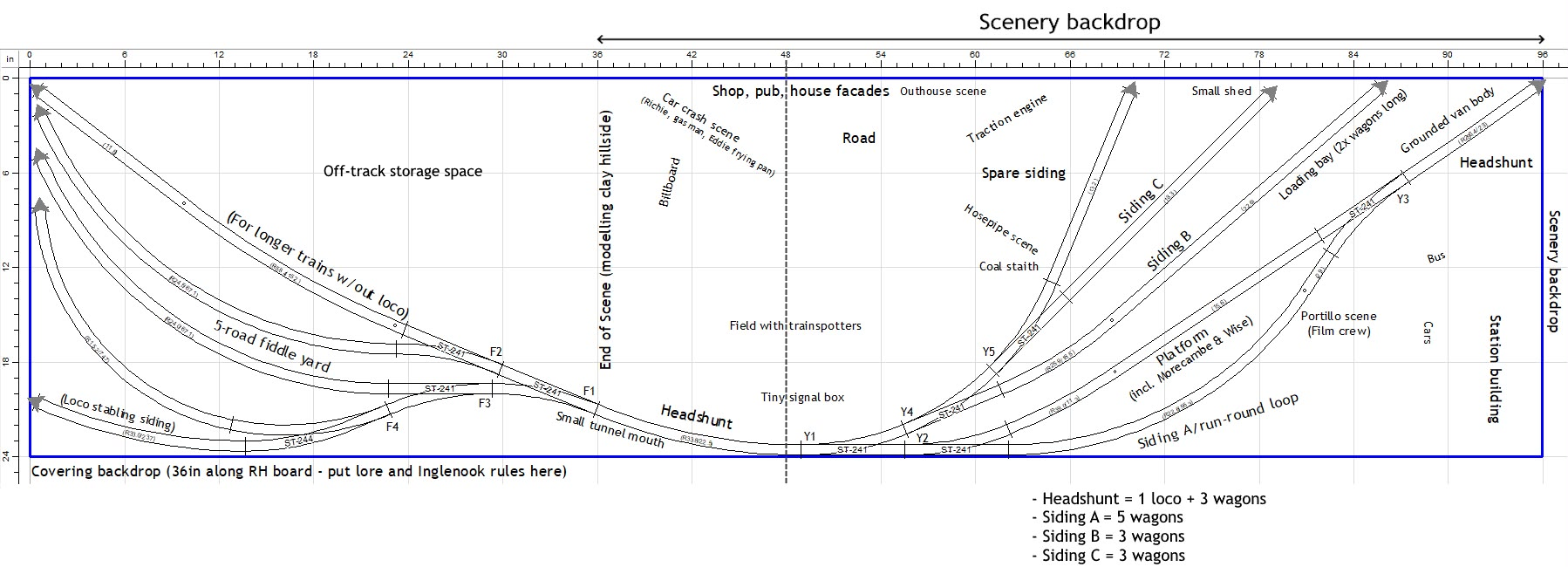
This layout is built on a pair of 4ft by 2ft Tim Horn baseboards, and includes a scenic section on the right-hand board and a quarter of the left-hand board, and a hidden fiddle yard on three quarters of the left-hand board. The trackwork consists of Peco Code 100 flex track and Peco insulfrog pointwork for both the scenic section and the fiddle yard, and the scenic section includes a built-in Inglenook style shunting challenge which will be explained later on. There are a total of nine sets of insulfrog points, including four in the fiddle yard and five in the main scene.
The main scene includes a small platform big enough for two Mk1s or three Tri-ang short-body clerestories, with a passing loop and a headshunt the latter of which is big enough to comfortably fit a small 4-4-0 like an LSWR T3 or any 0-6-0 tender engine - it is likely that a 2-6-0 may be able to fit, but we will need to test that. There are three sidings with various features, including a small goods shed in one siding, and a little loading bay, possibly for horses or other livestock, in another siding. On the track plan there is a siding marked as the 'spare siding' as it is not being used for the Inglenook shunting challenge element, but there will be rudimentary locomotive servicing facilities in this siding including a little coal staith and a water pump. On the right-hand side of the run-round loop there is a station building situated at ground level, inspired by the buildings at Havenstreet on the Isle of Wight Steam Railway, with a number of parked cars and a bus in front of it.
At the back, straddling the two boards will be a selection of building facades such as houses, shops and a pub, in front of a backdrop depicting English countryside (a similar backdrop may be placed on the end of the right-hand board, this has yet to be decided). Between the street at the back and the track at the front will be a village green, featuring either a war memorial or a gazebo in the middle, and a line of train enthusiasts by the fence next to the track with their cameras out (one or two may be attempting to trespass, but they'll deny it). At the station throat on the left-hand side there will be a small signalbox, similar to the disused one at the southern end of Kingscote station at the Bluebell Railway. The scenic section will be separated from the fiddle yard by means of a tunnel mouth.
The Inglenook shunting challenge element of this layout is built into two of the sidings and the run-round loop, with a view to conducting the challenge at various time intervals during exhibitions. When the challenge is taking place, the spare siding is sealed off, and the setup will ensure that the run-round loop (henceforth known as Siding A) will contain five wagons, and one of the other sidings in the yard (Siding B) will hold three wagons - another of the sidings will become Siding C for the purposes of the challenge, and will also be able to hold three wagons. The aim of the challenge is to create a train of five wagons in a specific order using the ones available, and the locomotive can only have up to three wagons in its possession at any one time. The first stage of our version of the challenge is to collect the brakevan and place it in the left-hand headshunt. The platform remains useable for push-pull trains and DMUs while the challenge is underway, and the locomotive (plus a GWR shunters truck if available) are kept in the spare siding before the start of the challenge - we could introduce an aspect which requires people to retrieve the shunters truck first but we will decide this later on.
There will be a number of humorous goings on around the layout for visitors to try and spot at exhibitions, including but not limited to Michael Portillo filming the next episode of Great British Railway Journeys, Ritchie and Eddie attempting to jump another man following a car crash which they caused (something something insurance details), a punch-up outside the pub, Morecambe and Wise waiting for their train, and a hosepipe being stolen from one of the houses to refill locomotive tanks because the water pump is temporarily inconveniently out of commission (there will be a burst water main to reflect this).
Control was originally planned to be DC to start with, with possible conversion to DCC later on, but will now be DCC from the outset, using Lenz 100 controllers, and the pointwork on the scenic section will be controlled using point motors - the fiddle yard pointwork can most likely be controlled manually as they will be behind the scenes, although this will be decided later on.
Locomotives and rolling stock for this layout will be entirely supplied by club members from our own collections, and will primarily include small and medium sized tank engines, and small tender engines like an SECR O1 or an LNER J15. Carriages and wagons will all be ready-to-run items made by such manufacturers as Hornby, Bachmann, Dapol, Rapido, etc, with some older items by Airfix and Mainline making an appearance as well.
Attached below is the track plan as created in SCARM.