
Lenz LZV100 Repairs
The 3 most common issues with the LZV100 are the battery is flat, an older version (before 3.6) of XpressNet and no DCC output or short circuit. Other faults will need more investigation and may not be repairable. The XpressNet AB signal comes from the 68 pin CPU (which needs a buffer, RAM, ROM, and crystal to work), through an RS485 chip, over a short ribbon cable to the sockets. The RS485 chip may be easy to replace, but the CPU would need special tools.
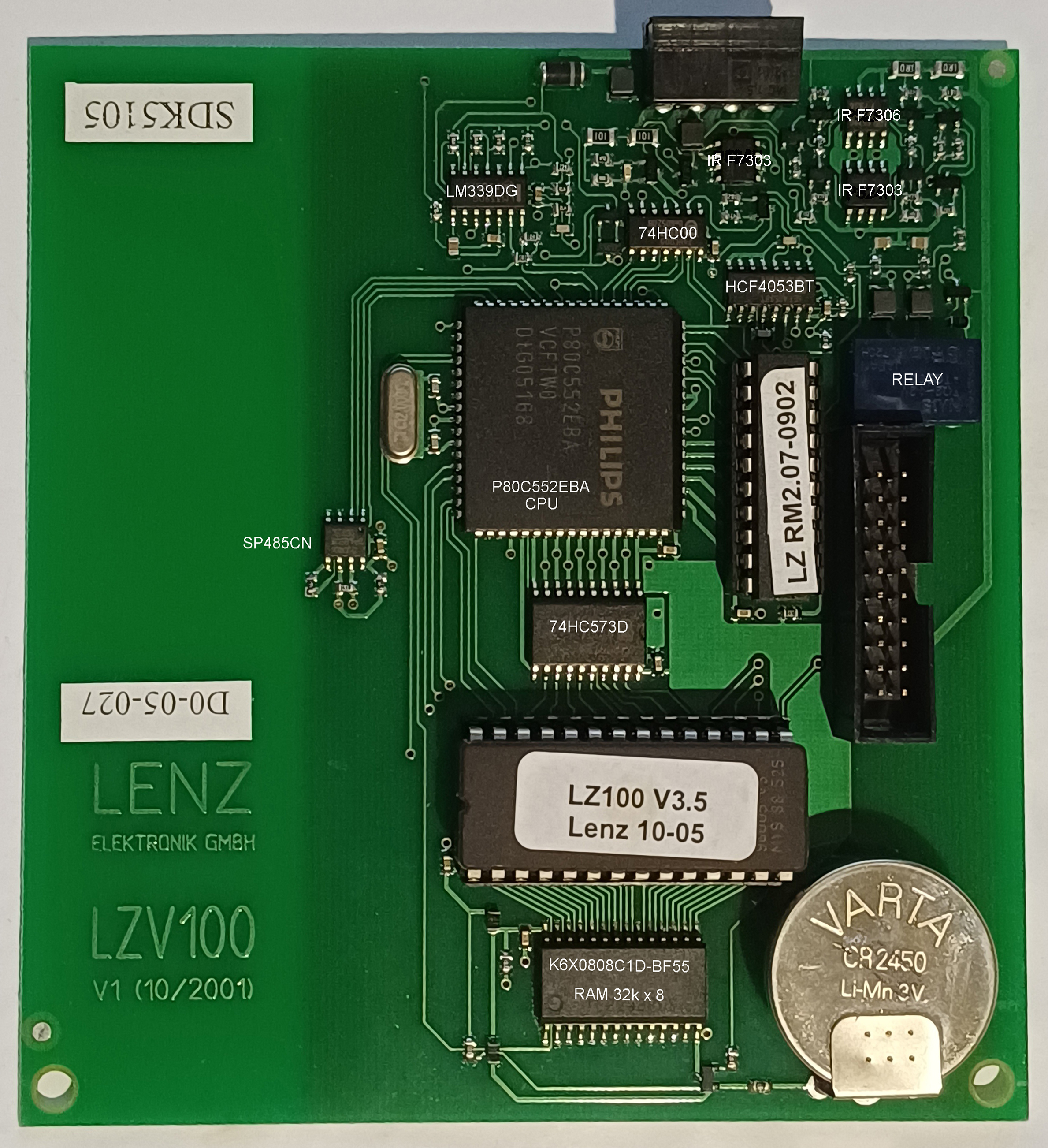
Inside the LZV100 are 2 PCBs joined by a short ribbon cable. The top board has the PQRS connector and the main CPU. The CPU has either an ultraviolet erasable EPROM or a onetime PROM with the program in it. The label gives the version and covers the UV window. Next to the PROM is the RAM chip and backup battery. The lower board is the booster and has the power input and DCC output connector UVJK. The DCC output uses an FET bridge circuit to drive up to 5 amps.
ER97 : The battery is flat.
The installed battery has a long life, but it‘s soldered in. It should be about 3 volts, if it close to 2 volts it needs replacing. It‘s a CR2450 with 600mAh capacity and a direct replacement is hard to find. Simpler and easier is to use a CR2032 with 225mAh capacity and a battery holder. Since this is a very common battery it should be easy to buy and slide in future. You may need to do a reset after replacing the battery.
Version 3.6 upgrade.
Version 3.0 only had 13 functions F0 to F12 and 255 CVs, 3.5 may also have had 13 functions and 999 CVs, 3.6 has 29 functions and 1024 CVs. This upgrade is simple if you have a copy of a 3.6 chip. Slide a slim screwdriver between the chip and the socket to lift out the old chip and push in the new chip. A small indent in one end shows which way round it should be inserted. If the old chip has a round window under the label, it can be erased and re-programmed with the current version. You need a UV eraser, universal programmer and a working 3.6 chip to copy. The UV erasable chip is an 27C256 with 32k bytes. It takes about 15 minutes under a strong UV lamp to erase the old contents. After re-programming the window needs to be covered as sunlight can start to erase the program. You may need to do a reset after upgrading to 3.6.
Lenz LZV100 reset.
The Lenz instructions are:
1) Set your handheld to operate locomotive 00 (the analog locomotive)
and bring that locomotive to a stop.
2) Press the F4 key 25 times in succession. You may notice that after the 20th time
that brief power interruption occurs on the layout.
3) Remove power from the LZV100 by turning off power to the transformer (not ST key).
Unfortunately, it seems to need 25 of "F4 on", after 20 "F4 on"s the redlight goes off
for a half a second. Since the F4 mode is usually toggle, (not momentary)
it also needs 25 "F4 off"s, making 50 presses of the F4 key.
If you watch the red LED, you can tell if 25 or 50 are needed.
FET change.
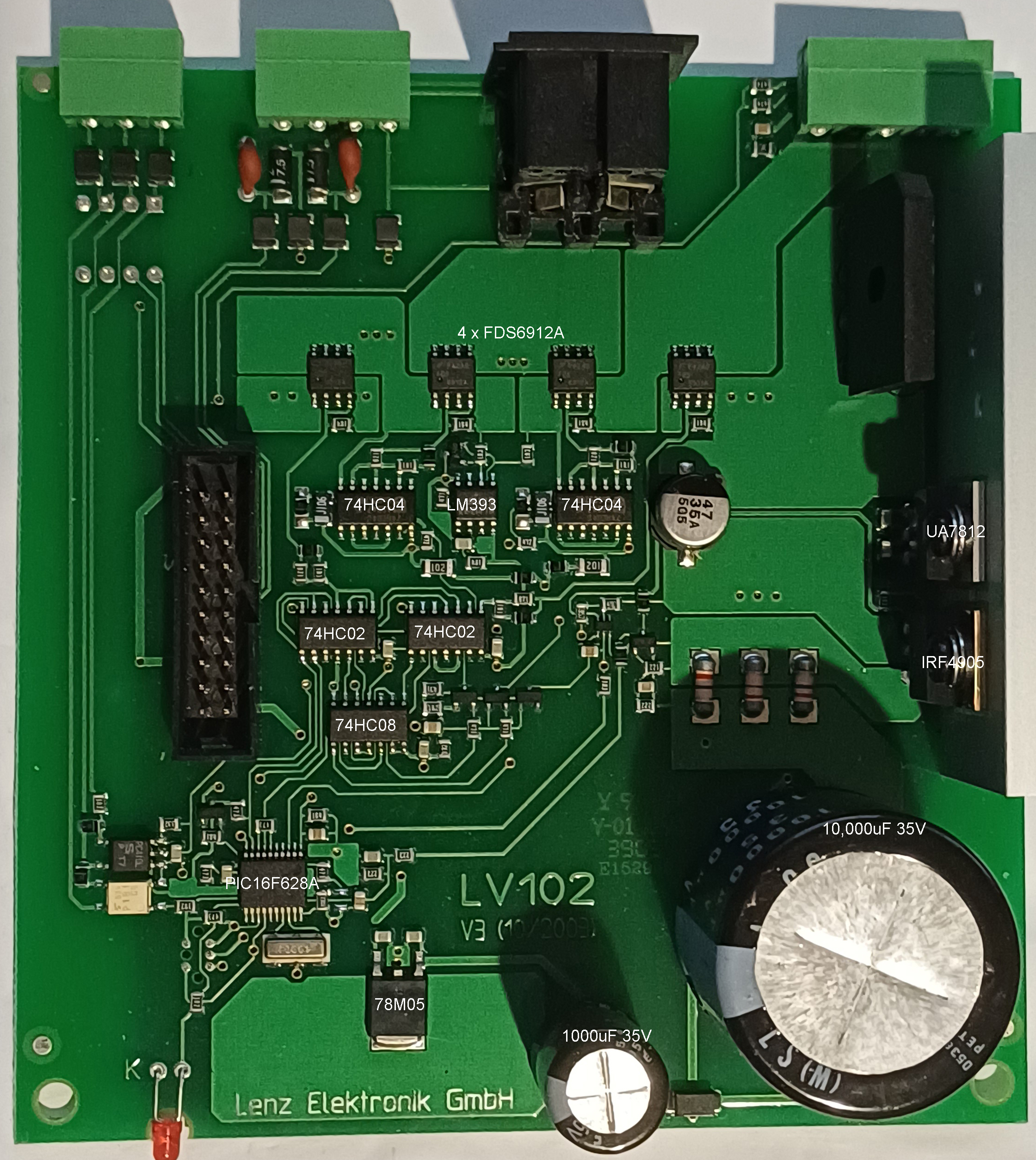
These are on the booster PCB. The only difference between the PCB in the LV102 booster unit and booster in the LZV100 seems to be the missing 20 pin ribbon connector, LMAB connectors and 12 volt regulator.
If you put the power into the wrong pins or have an associated booster and connect it the wrong way on the J and K pins it will probably blow 2 of the 4 output FETs. This usually results in a short circuit that will not clear or only half the voltage out. These FETs are the 4 x FDS6912A on the booster PCB near the edge with the connectors. They are very cheap at £6 for 10, easy to break, very small and hard to replace. They are rated at 30 volts and 6 amps, and each chip has 2 FETs inside and these are wired in parallel.
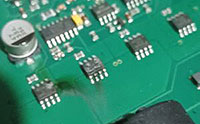
Black soot (left photo) and/or lumps in the plastic (right picture) indicate which FETs need to be replaced.
Google "SMD chip replacement" or "SMD rework" for hints on replacing these. Also there are SMD (surface mount device) practice kits on Amazon, eBay and MERG. The first step is to remove the damaged chips without damaging the PCB or the nearby resistor. The PCB can de-laminate at temperatures above 120°C so take care and be quick if using a soldering iron at 300°C or more with 180°C solder or 220°C lead free solder.
These chips are about 6mm square and getting all 8 legs unsoldered at the same time without getting the PCB tracks too hot and melting the attachment to the fibreglass base is very difficult. I find it is best to carefully cut some of the legs on the chip using small wire cutters. Take care as the PCB may already be damaged when the chips were blown. The 4 legs on the side nearest the connector are all on a large PCB land and easy to cut. There is a thin PCB track joining pins 2 and 4 (the gate pins) which is the most likely to lift. So, I carefully cut pins 1 and 4 putting as little stress on the PCB as possible. Unsolder pins 2 and 3 (also pins 6 and 7) and remove the chip. The pads then need to be cleaned up, and leg parts removed.
For a quick test after removing the faulty chips, the 2 boards can be powered up with a controller, and the short circuit should have gone. Power down again to add the chips. Apply some electrical flux, carefully position the new chip and solder in using a small bit in the iron, making sure the pin 1 mark is in the same place as the other FETs and that there is no solder bridge across any pins. Good lighting, magnification and a good soldering iron are necessary.
Hot air SMD rework tools are good, but only for SMD work, you can‘t use them for anything else. You also need solder paste which you can apply very small amounts via a small needle, and this has a shelf life of about 6 months before it goes too solid to use. It also has a lower melting point (140°C) making PCB damage less likely. Using hot air and solder paste, the components tend to centralize themselves on the pads using surface tension.